Running Puppeteer on AWS Lambda Using Serverless Framework
Instructions to run locally
$ npm install
$ sls offline
To Deploy on AWS
- Select your AWS profile (e.g.
export AWS_PROFILE=<your aws profile>or--aws-profile <your aws profile>) and run
$ sls deploy
About Project
When it comes to AWS Lambda function , they have their own limits as follows
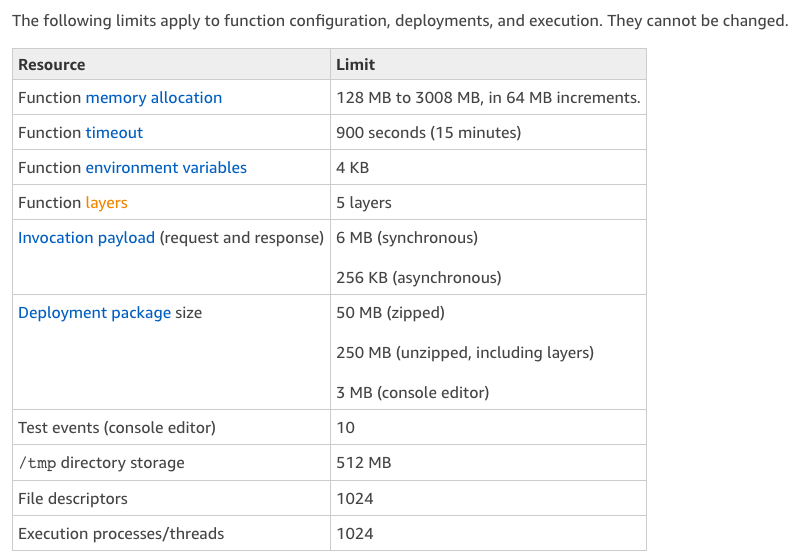 So , When you try to use Puppeteer your deployment package size(unzipped) easily go's above 250 mb because When you install Puppeteer, it downloads a recent version of Chromium (~170MB Mac, ~282MB Linux, ~280MB Win) that is guaranteed to work with the API.
Solution
This example uses puppeteer-core (no bundled Chromium) together with @sparticuz/chromium, a Brotli-compressed Chromium build made for Lambda.
Architecture note:
@sparticuz/chromiumonly ships x86_64 Chromium binaries (no arm64 build), so this is the one example in this repo pinned toarchitecture: x86_64instead of the usualarm64default. Keep the@sparticuz/chromiummajor version aligned with whatever Chromium version yourpuppeteer-coreversion expects — see the Puppeteer Chromium Support page.
How ??
1. Install the dependencies
$ npm i puppeteer-core @sparticuz/chromium
2. Use chromium.executablePath() in your handler
/* handler.js */
import chromium from '@sparticuz/chromium';
import puppeteer from 'puppeteer-core';

export const hello = async (event) => {
  const { url } = event.queryStringParameters;
  const browser = await puppeteer.launch({
    args: chromium.args,
    defaultViewport: chromium.defaultViewport,
    executablePath: await chromium.executablePath(),
    headless: chromium.headless,
  });
  const page = await browser.newPage();
  await page.goto(url, { waitUntil: 'networkidle0' });
  const content = await page.evaluate(() => document.body.innerHTML);
  await browser.close();
  return {
    statusCode: 200,
    body: JSON.stringify({ content }),
  };
};
That's all, you can now use Puppeteer on AWS Lambda.
To Test It Locally
$ npm i serverless-offline
- Make the following request (replace
{{URL}}with the page you want to get content for)
curl -X GET \
  'http://localhost:3000?url={{URL}}' \
To Deploy on AWS
$ sls deploy
- Make the following request (replace
{{URL}}with the page you want to get content for and{{lambda_url}}with your lambda url)
curl -X GET \
  '{{lambda_url}}?url={{URL}}' \